
All the blogs

What is physics? A visual introduction
Physics is the science of matter, energy, space, time and the forces between them. A short visual guide to what it studies, how it works and how to start.
Go to blog
Class 12 Physics Complete Guide – All Chapters with Formulas & Examples
Class 12 Physics (CBSE 2025–26) chapter by chapter: clear explanations, key formulas, derivations and exam strategy from electrostatics to semiconductors.
Go to blogWhy is the sky blue?
Air molecules scatter short-wavelength blue light about six times more than red — Rayleigh scattering. The same effect turns sunsets red and clouds white.
Go to blogWhy does metal feel colder than wood?
Metal and wood in the same room are at the same temperature. Metal feels colder because it conducts heat out of your skin much faster than wood does.
Go to blog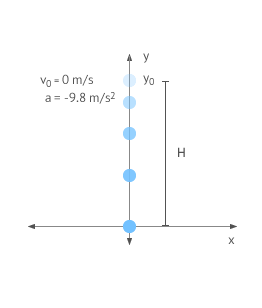
How does a bouncing ball work?
A bouncing ball loses speed at each impact, keeping a fraction e (restitution). Every bounce reaches e² of the last height — the maths, with a simulation.
Go to blogHow do you code a bouncing ball?
Gravity, a floor and a restitution factor make a bouncing ball — but a naive floor check changes the energy. Handle the impact time exactly, in JavaScript.
Go to blogWhat is the difference between elastic and inelastic collisions?
Momentum is conserved in every collision; kinetic energy only in elastic ones. See both cases with worked numbers and the restitution coefficient that links them.
Go to blog
Vectors: components, addition, dot and cross products
A vector has magnitude and direction. Split it into components and addition, scaling, dot and cross products all become simple arithmetic.
Go to blogWhat is the unit circle?
On a circle of radius 1, cosine and sine are the x and y coordinates of a point at angle θ. Tangent and the other functions are lengths too — and sin(ωθ+φ) is a wave.
Go to blog
How does a ball accelerate toward a target?
Acceleration is how fast velocity changes. Aim a constant acceleration at a target and the ball speeds up, overshoots and loops back — here is why.
Go to blogWhy do we see lightning before we hear thunder?
Light travels almost a million times faster than sound. Count the seconds between flash and thunder, divide by 3, and you have the distance in kilometres.
Go to blog
How does free fall work?
In free fall every object accelerates at g ≈ 9.81 m/s², whatever its mass. Equations, gravity on other worlds, and how air resistance sets terminal velocity.
Go to blogHow do you code air resistance?
Add a drag term proportional to v² to a falling object and it reaches a terminal velocity. Code it in a few lines of JavaScript and check it against the exact solution.
Go to blogHow do airplanes fly?
A wing pushes air downward and the air pushes the wing up. That lift grows with speed squared and balances the plane's weight in level flight.
Go to blogHow does an inclined plane work?
On a ramp, weight splits into mg sin θ along the slope and mg cos θ into it. Friction decides whether the block slides — the maths, with a simulation.
Go to blogWhat is centripetal force?
A body in circular motion always accelerates toward the centre, needing an inward force F = mv²/r. If that force vanishes, the body flies off straight.
Go to blogWhy do astronauts float in space?
Gravity at the ISS is still almost 90% of what it is on the ground. Astronauts float because they and the station are in constant free fall around Earth.
Go to blog
How does a spring work?
A spring pushes back in proportion to how far you stretch it (Hooke's law) — which is why a mass on a spring oscillates. The physics, with a simulation.
Go to blog
How does a pendulum work?
A pendulum's period depends only on its length and gravity, not its mass: T = 2π√(L/g). The physics of the swing, energy and damping, with a simulation.
Go to blogHow do you simulate a pendulum in code?
Turn the pendulum equation into a state you can step forward in time. Compare explicit Euler, semi-implicit Euler and RK4 with real energy-drift numbers, in JavaScript.
Go to blogWhy is the double pendulum chaotic?
Hang one pendulum from another and the motion becomes unpredictable: a start difference of one millionth of a radian grows to a completely different path within seconds.
Go to blog
How does projectile motion work?
Gravity pulls a projectile down while its sideways speed stays constant; together they trace a parabola. The equations, range and angle, with a launcher.
Go to blog
The Three-Body Problem: The Equation That Broke Physics
Two bodies under gravity are perfectly predictable; three are chaotic. Why the three-body problem has no formula — and what the Netflix show gets right.
Go to blog
How Two Sliding Blocks Compute π — The Most Surprising Result in Physics
Two frictionless blocks and a wall, all collisions elastic: count the clacks and you get the digits of π. The physics, from first collision to proof.
Go to blog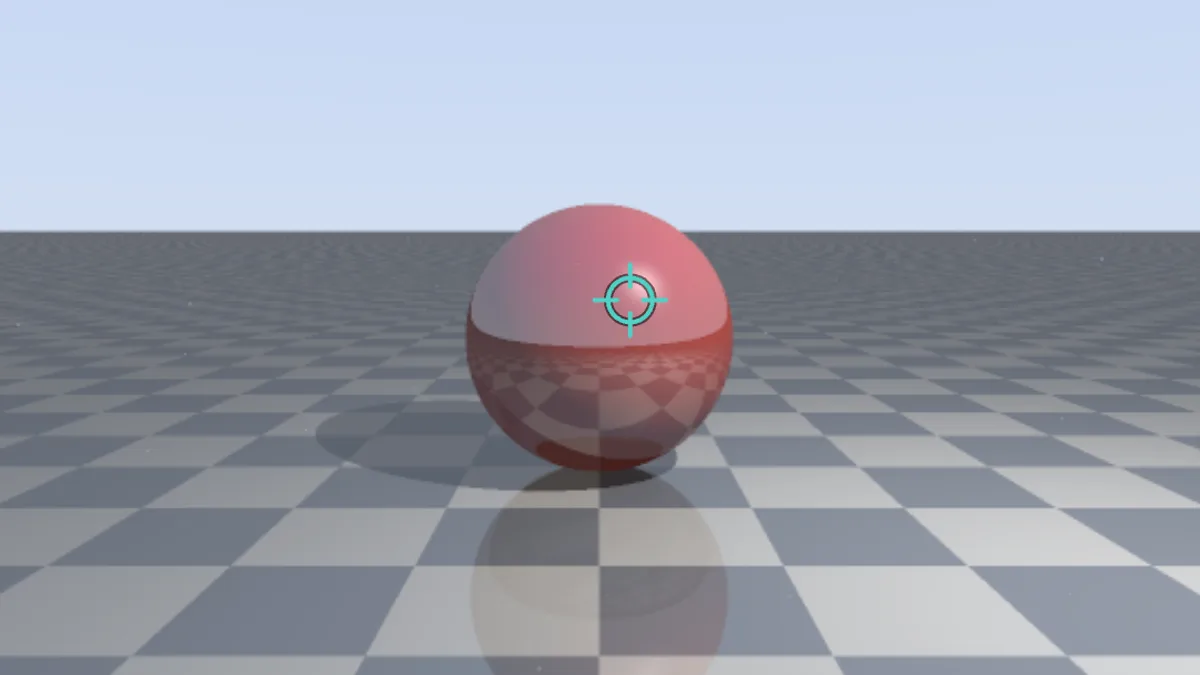
How does ray tracing work?
Ray tracing follows straight-line light rays backwards from the camera through each pixel, then applies the laws of optics where they hit to decide the pixel's colour.
Go to blogKirchhoff's Circuit Laws Explained
Why current splits at a junction and why voltages around a loop always add to zero — with a fully worked two-loop network, sign conventions that actually survive contact with a problem, and the nodal method the simulation uses to solve any circuit you build.
Go to blog